
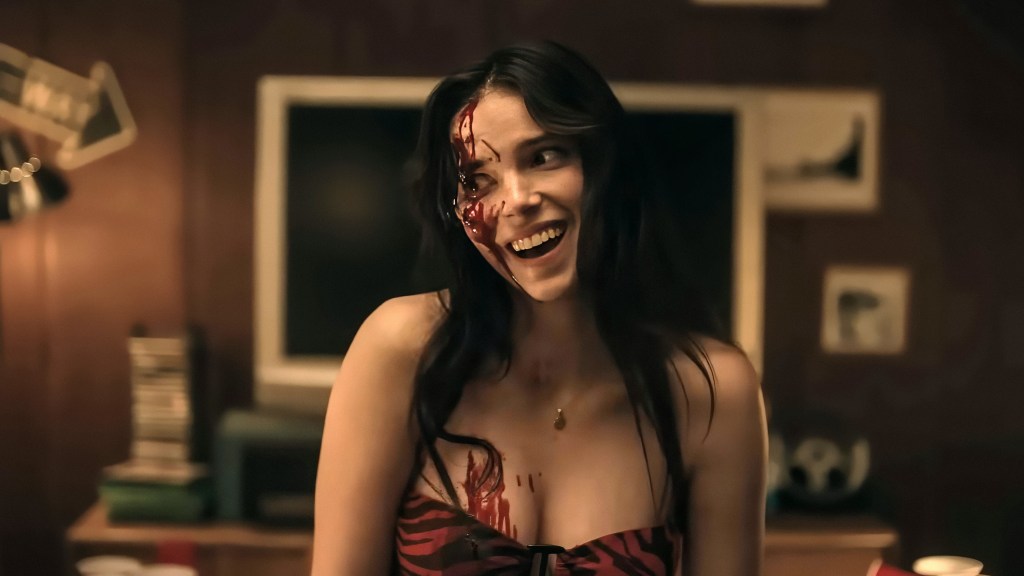
Curry Barker's second feature begins with the architecture of a joke and ends with the architecture of a crime. A shy music-store employee buys a vintage novelty toy that promises one wish. He wishes his coworker would love him more than anything in the world. She does. The film understands exactly what that sentence means. Barker, who came up making the viral YouTube short Milk & Serial, treats the Monkey's Paw premise as a working machine for examining male want, and the result is the rarest thing in current horror: a film that diagnoses its protagonist rather than identifies with him.
Inde Navarrette plays Nikki before and after the wish, and the distance between them is the film's terror. Before, she is the sarcastic intelligence at the center of the store. After, she is a creature whose self has been replaced by demand. Navarrette doesn't soften the transition. The critics reaching for Isabelle Adjani in Possession as a comparison aren't reaching. Michael Johnston plays Bear, the wisher, with the harder assignment. He has to remain recognizable as the same recessive young man who couldn't ask the question out loud, even as his choices accumulate into something monstrous. He stays small. He never becomes a villain in the conventional shape. The film refuses to let him.
Taylor Clemons photographs the music store as a closed economy of fluorescent light and worn vinyl. Interiors don't perform charm. They perform the limited horizon of the protagonist's life. Rock Burwell's score sits low, more drone than melody. It doesn't telegraph dread. It hums beneath the action the way obsession does. Production designer Vivian Gray builds Bear's apartment as a museum of refused contact. Barker, who edits the film himself, cuts to an off-kilter rhythm. Jump scares drop three frames after the obvious mark. Comedy beats land where horror was building. The pacing itself argues that obsession does not conform to genre conventions.
The film refuses the inversion lazier horror would reach for. Barker does not tell this story from Nikki's perspective. The camera stays with Bear. The audience is never permitted to romanticize his predicament. He made a choice. He took her consent and traded it for an outcome. The film treats the wish as the act, not a magical bystander to fate. The toy is never mythologized. It is just the mechanism by which an intention becomes the world. This is the moral architecture genre rarely musters. The protagonist is the perpetrator. His interior life does not redeem his action.
Where the film slightly strains is in its third-act ambition. Barker, who came up making viral YouTube horror, has instincts that occasionally pull toward the maximalist set piece. A late sequence in the music store reaches for canonical horror imagery and finds it. The reach is impressive. The intimacy of the first hour was more original. The genre-tradition payoff satisfies but is more conventional than what came before.
Focus Features bought this seven-hundred-fifty-thousand-dollar film for fifteen million, and the math is justified by what's on screen. The film understands its own subject. It is not a film about a young man unlucky enough to get what he asked for. It is a film about how easily wanting becomes taking. The horror isn't the wish granted. The horror is the wish itself.