
Bassam Tariq's Your Mother Your Mother Your Mother stages a revisionist Western in the sprawl of Houston, and its argument is that righteousness and violence cannot share a household without one of them giving way. The setup is stark. Latif, a devout Muslim and a hitman, loses his wife and is left with three children, one of them an infant who needs breast milk. Tariq, whose earlier feature was Mogul Mowgli, treats the killer's code and the father's duty as a single problem. The film premiered at TIFF and reaches theaters September 25 through Amazon MGM Studios, a studio release with the instincts of a personal one.
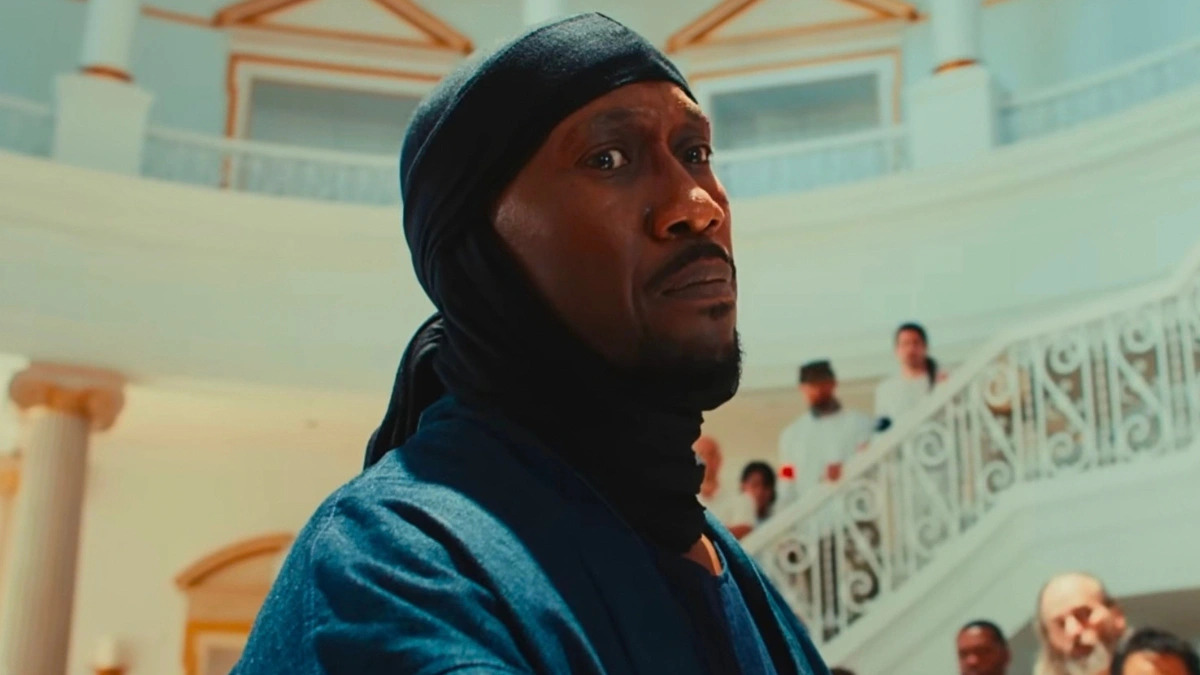
Mahershala Ali plays Latif with his weight held low and his face mostly shut. He rehearses prayer while pricing a threat, and the physicality does the work that dialogue would otherwise do. No speeches. Just a man calculating what he can still afford to be. John Cho takes the opposite approach as a fundamentalist pastor who pursues the family, colorful where Ali is withheld, and Giancarlo Esposito and Tramell Tillman fill out a supporting cast that gives the city some crowded texture. The children are never props.
Cinematographer Katelin Arizmendi photographs Houston in heat and grit, a city that clings to the skin, and the visual urgency in the chase sequences never turns decorative. Son Lux supplies the score, which understands that a film about faith needs room for silence as much as for pulse. Editor Cam McLauchlin cuts between the kitchen table and the killing floor without apologizing for the join. Each department keeps its eye on the same question: what does a body owe to its god, and what does it owe to a baby?
What the film understands is that violence, for Latif, is a place to put pressure that fatherhood has no other outlet for. Tariq refuses the balletic gunplay that the hitman genre sells. He refuses, too, to reduce his lead to a symbol, though the image of a Black Muslim man inhabiting the gunslinger's role carries obvious political charge. The film lets that charge sit where it naturally falls and moves on. Latif and the pastor hunting him share more than either would admit, and the script declines to rank their faiths.
The seams show. The action choreography runs uneven, and in the messier scuffles it obscures the very emotional beats it should sharpen. A recurring strain of humor lands awkwardly against the grief underneath, and the ending is divisive by design. These moments strain the tonal coherence. They also mark a filmmaker unwilling to file down a strange idea until it fits a genre, and the strain is part of what the film is about.
Hitmen in movies are usually allowed one soft spot, a dog or a daughter, to make them bearable. Tariq gives Latif an infant with an appetite and nothing else to bargain with. The result is an action film with a conscience it cannot switch off. Righteousness, here, is not a posture. It is a chore that has to be done at three in the morning.