
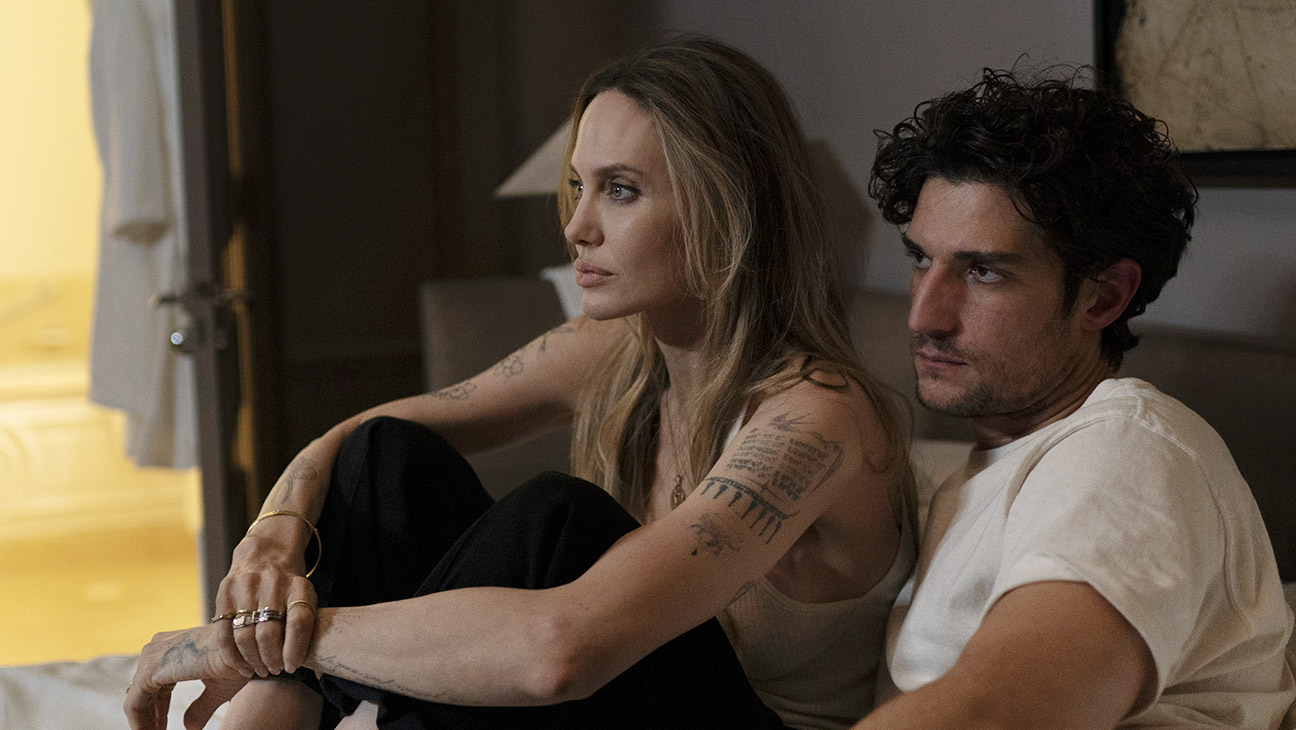
Alice Winocour has spent her career filming bodies under duress, from the institutionalized patient of Augustine to the astronaut drilling her physiology toward orbit in Proxima. Couture, set across a single Paris Fashion Week, hands her another body in crisis. Angelina Jolie plays Maxine, an American horror director shooting a commissioned short for a fashion house when a call from her doctor turns a routine test into a breast cancer diagnosis. Winocour calls the film a memento mori. It lands hardest when it treats the body as material to be measured and remade, and stalls whenever it tries to put that into words.
Jolie works in a register of guarded composure, a woman managing her own face as carefully as the show she was hired to design. The performance withholds. That glazed sadness can read as inertia, and the film does not always hand her enough to push against. Her strongest scenes come opposite Vincent Lindon as the oncologist who will not let Maxine defer surgery for the sake of a shooting schedule. He is kind and immovable. Around them, Ella Rumpf's makeup artist and Anyier Anei's first-time model from South Sudan circle the main story without ever fully entering it.
The craft team supplies the film's real argument. Cinematographer André Chemetoff shoots the ateliers as workshops rather than fantasies, holding close on pinned fabric and bare skin. Production designer Florian Sanson rebuilds the machinery of a couture house, and Winocour secured the actual Chanel rooms on Rue Cambon, the first fictional production allowed to film there. Costume designer Pascaline Chavanne, a multiple César winner, gives the runway a grandeur that has to justify the human cost of building it. The score by Anna von Hausswolff and Filip Leyman holds a low dread beneath the glamour. The sharpest image belongs to editors Julien Lacheray and Lilian Cobeille: the red adhesive strips of Maxine's biopsy, cut against the patterning tape on a workshop mannequin. Two bodies marked for alteration.
What Couture understands is that illness arrives mid-task, with no clearing of the calendar to receive it. Maxine's refusal to leave the shoot for a single hour says more about the pressure women carry than any monologue could. The film declines the makeover arc and the survivor's uplift. Its closing runway, staged outdoors in thunderous rain with gowns wrenched sideways by wind, reaches for something elemental, a catharsis wearing the costume of a fashion show.
The reach exceeds the grip. Ada and Angèle are given lives but not stakes, and their scenes accumulate as texture instead of counterpoint. Winocour, who wrote the script with Jean Stéphane Bron, now and then hands Maxine dialogue that explains the film's themes back to it ("Do you think we're responsible for what happens to us?"), and the spell thins each time. The three-women structure dilutes the one story carrying genuine charge.
Still, the central rhyme holds. A body in an atelier is something to be measured and finished against a deadline, and Maxine's has become exactly that, against a deadline she never agreed to. Couture keeps reaching for language when the image already had it. The seam knew before the script did.