
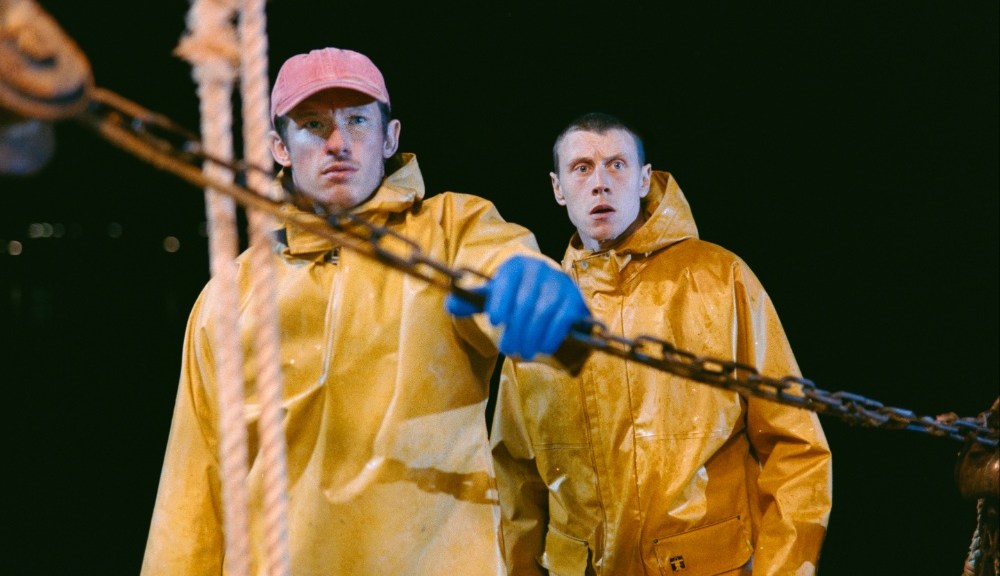
Mark Jenkin makes films the way a cabinetmaker builds a chair, by his own hand from raw stock to finish, and Rose of Nevada is the most assured object he has turned out. His third feature folds the analog severity of Bait into the genre unease of Enys Men and sails the result into a dying Cornish fishing village. The film argues that economic desperation will grab any rope thrown to it, even a cursed one, and that the past a broke community romanticizes is a place you can drown in.
George MacKay plays Nick, an unemployed young father who signs onto the returned boat to fix a cracked roof and keep his family fed. Callum Turner plays Liam, a drifter who slips into the crew and then into another man's life without flinching. MacKay does the harder work. He carries the film's reality on his face, the slow panic of a man who notices the harbor holds the wrong people and the calendar the wrong year. Turner gives Liam an opacity that curdles, his easy adaptation becoming a threat in itself. Both actors submit to Jenkin's brisk, post-dubbed register and find feeling inside it instead of fighting it.
The credit block is the story. Jenkin writes, directs, shoots, edits, scores, and builds the sound design himself, and the film is the case for why that matters. He works on 16mm with a hand-wound Bolex, and the grain is not nostalgia; it is texture you could scrape off the screen, rust and rope and rain-warped doors lacquered in oily primary color. His organ score reverses and clips against his own kinetic cutting until time stops keeping order. The post-synced sound, every gull and groaning hull assembled after the shoot, holds the world a half-step off from real. One pair of hands made all of it, and the seams are the point.
What Jenkin understands is that a ghost story and a story about madness are the same story told from different chairs. The boat vanished in 1993 with its crew, and the village reads its return as luck rather than warning, never mind the words gouged into the wood telling them to get off. The film refuses to confirm whether Nick has slipped through time or come loose from his own mind. It refuses, too, to sentimentalize the hardship it photographs so beautifully. The fishing life that looks like heritage in the frame is the same trap that hollowed the town out.
That reticence carries a cost. Jenkin withholds so steadily that the second half can read as a closed circuit, admiring its own loop more than it moves you, and at least one major notice landed cool on exactly that chill. The film keeps the audience at the distance it keeps its men. The austerity is built on purpose, not lost nerve, but it asks a patience some viewers will decline to extend.
Almost nothing in current independent film looks or sounds like this, and the strangeness is earned rather than worn as a costume. Jenkin has built a machine for feeling time as loss, plank by plank, and he will not hand you the manual. The village wants the boat to carry it back to better years. The boat only carries it under.