
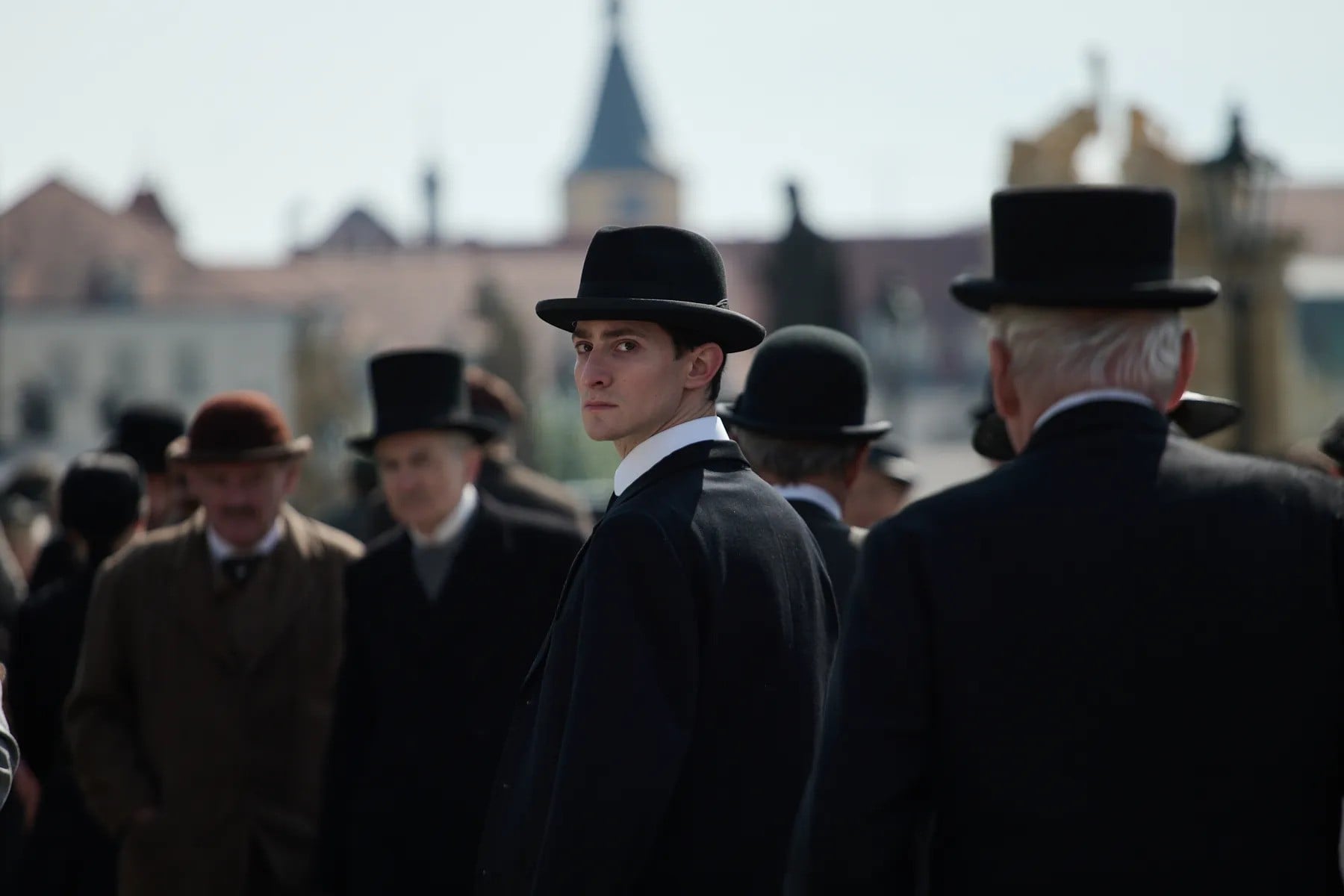
Agnieszka Holland read Franz Kafka for decades before she made a film about him, and Franz carries the weight of that reading in a way most literary biopics never attempt. Poland's entry for this year's international feature Oscar, released stateside by Cohen Media Group on August 21, it runs 127 minutes and covers a whole life, Prague birth to Vienna death. Holland knows the form cannot hold him. She builds the film out of that knowledge and then, repeatedly, forgets it.
Idan Weiss plays Kafka as a man perpetually calculating the cost of being looked at. Gaunt, watchful, faintly amused by his own dread. Weiss took best actor at Gdynia for it, and the award tracks; he holds the center without once reaching for pathos. Peter Kurth's Hermann Kafka is the harder achievement, a bullying father played as gregarious and emotionally limited rather than monstrous, which makes the damage legible instead of theatrical. Sebastian Schwarz carries Max Brod's mix of envy and lifelong loyalty. Carol Schuler, as Felice Bauer, absorbs the cruelty of Kafka's own written descriptions of her and returns something like dignity.
Tomasz Naumiuk photographs turn-of-the-century Prague in daylight so flat and civil that the paranoia reads as a private defect rather than a response to anything. He took the cinematography prize at Gdynia as well. Henrich Boraros builds a secular Jewish Prague that the Holocaust would later erase, and the sets decline the sepia reverence such recreations usually receive. Pavel Hrdlička's editing is where Holland's real argument lives, cutting between staged recollection, direct-address interviews shot like television news, and expressionist inserts that answer to no timeline. Marek Epstein's script gives the jumping its permission.
The film refuses the single-episode biopic, the version of the form that usually works, and goes cradle to grave on purpose. It also refuses to pretend that decision is sufficient. Friends and relatives turn to the camera and answer questions from a documentary that does not exist. Kafka discovers he is being watched through peepholes in his bedroom wall, and the cut reveals present-day museum tourists in Prague studying a replica of the room. The joke lands. It also names what the film is actually about, which is Kafka's afterlife as merchandise.
The literalizations are the problem. Hermann compares his son to an insect and an insect duly crosses the tablecloth. Franz feels monstrous on an adulterous date and his fingers go webbed. The insurance-office material arrives as a stylistic spoof of Welles's The Trial, a gesture that cites a reference rather than earning one. Critics have split hard on whether the metafictional apparatus is a method or an alibi, and the film supplies evidence for both readings.
What Holland understands, and what her own apparatus keeps interrupting, is that Kafka's life was not exceptional. The insurance job, the father, the tuberculosis, the engagements broken and resumed: none of it accounts for the sentences. Franz circles that fact for two hours without ever stating it, which may be the most Kafkaesque thing in the picture. Biography can only deliver the man. The work stays sealed.