
Ross McElwee has filmed his own life for nearly fifty years, and Remake is the film where the practice answers for itself. It began as a lark. Steve Carr, the Hollywood director of Daddy Day Care and Paul Blart: Mall Cop, wanted to remake Sherman's March, McElwee's 1985 landmark, as a fiction feature, and McElwee, only vaguely interested in the outcome, filmed the development process as it mutated. Then the project was overtaken by the death of his son Adrian, from a fentanyl overdose in the family's Cambridge home in 2016, and the making-of becomes an apology, delivered in the only language its maker has ever spoken. McElwee's first feature in fourteen years premiered at Venice, where it took the Golden Globes Impact Prize for documentary, and opened Friday at New York's Film Forum through Music Box Films.
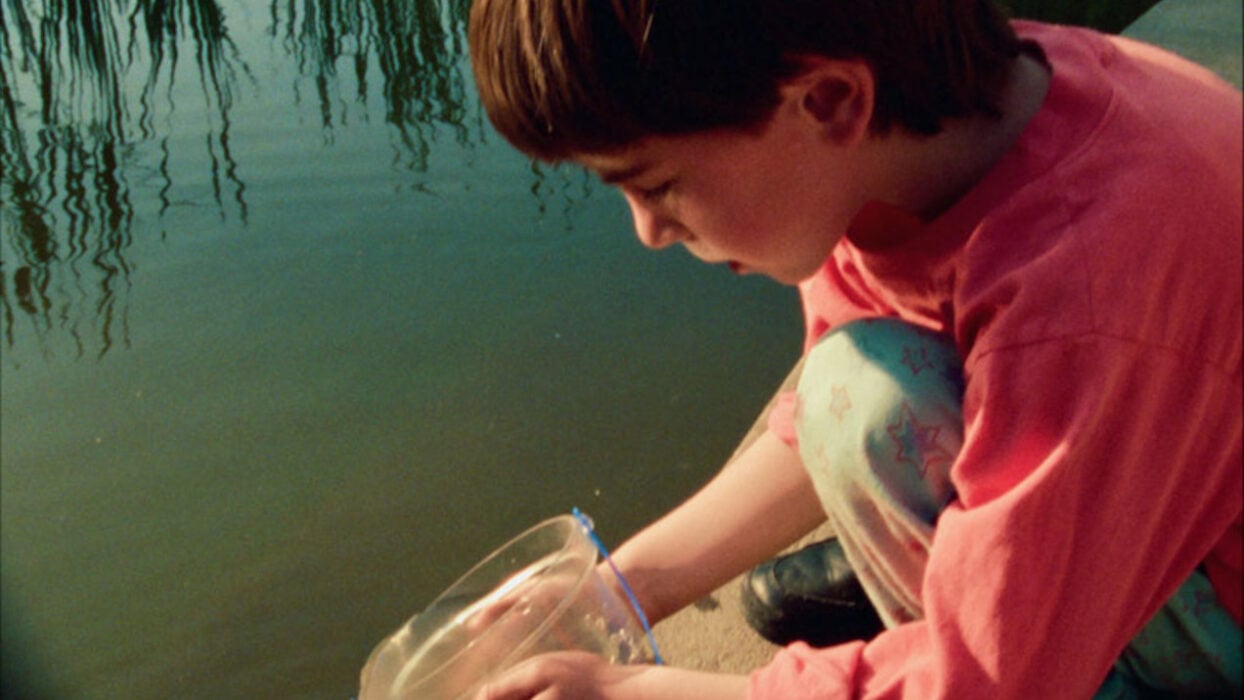
Adrian is the film's central performance, assembled rather than given. McElwee filmed his son a few minutes at a time from childhood on, and the archive holds a life. A boy at the water's edge who loves "the deep surprise of the ocean." A kid in Paraguay serving his parents dinners made of stones from a pretend restaurant. A teenager pouring himself into a music blog, a novel, a script, a clothing line, hunting for an outlet that fit. By 2011 he is in Venice for the premiere of Photographic Memory, the film his father made about their already strained relationship, shooting himself in red-carpet attire and cutting the footage to a Rick Ross remix. Parody or aspiration, the film cannot decide. Neither can McElwee, whose voiceover carries the wound: "I used to call myself a filmmaker, I used to call myself your father."
The credit block carries the argument. Cinematography: Ross McElwee and Adrian McElwee. Father on 16mm, son on iPhones and GoPros. Adrian left footage of his own, including an unfinished documentary shot in Colorado to track his progress toward sobriety, in which he interviews friends and fellow addicts with his father's gift for drawing people out. Joe Bini, longtime editor for Werner Herzog, cuts the material with McElwee, and the shape they find is associative, doubling back through Charleen, In Paraguay, and Photographic Memory the way memory doubles back on a sore spot. Mark Meatto produces alongside McElwee himself.
What the film understands is that the camera gives and takes in one gesture. Charleen Swansea, the boisterous center of Sherman's March, now lives with Alzheimer's and cannot remember making it. "Things just disappear," she tells the director, who keeps shooting. The footage outlasts the memory it records. It also built a distance McElwee can no longer call neutral, and he worries on camera that the son in the archive is becoming "a fictional character on the screen, someone who's never lived before." In the background the remake deflates from feature to limited series to half-hour sitcom, commerce doing to Sherman's March roughly what time is doing to Charleen. The film refuses to rank the losses. Both ask what survives of a life once it turns into material.
The tonal gamble is real. Paul Blart jokes share a running time with a son's death, and a lesser film would use one to hide from the other. Here the collision is load-bearing. Adrian, commercially minded where his father never was, wanted the remake made; art, he tells his father in one clip, is "not about what you want to do," and the personal films amount to a "spoiled attitude." The stalled adaptation is not comic relief. It is the argument father and son never got to finish.
McElwee is 78. He has outlived his friend's memory of their films together, and he has outlived his son. Remake makes no case that the filming helped. Its case is harder: the footage is where Adrian now lives, and an apology addressed to a screen is still worth making. A remake is a second pass at old material. Grief permits none. The camera keeps what it could not protect.