
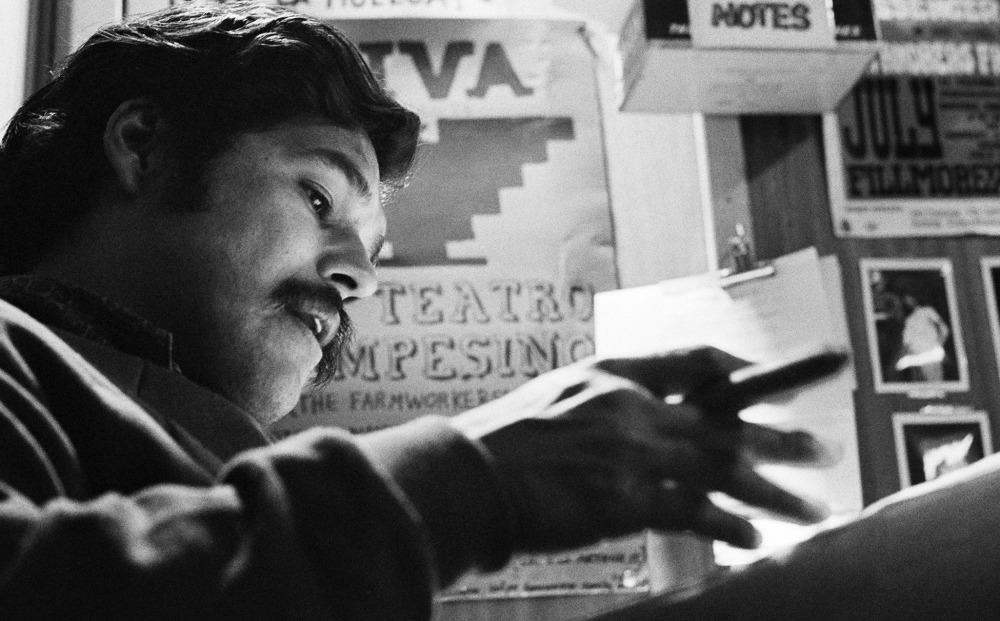
David Alvarado's American Pachuco: The Legend of Luis Valdez is a conventional documentary carrying an unconventional cargo. The form is familiar: chronology, testimony, archival collage. The argument is the archive itself. Alvarado's team worked with UC Santa Barbara to digitize over 80,000 feet of deteriorating El Teatro Campesino film that was close to being lost outright, and the rescued material does the arguing a legacy doc usually leaves to its talking heads. Luis Valdez founded a theater on the bed of a flatbed truck during the Delano grape strike and staged agitprop for the farmworkers walking the picket line. The film premiered at Sundance in January, where it won both the U.S. Documentary Audience Award and the Festival Favorite prize, and opened Friday at New York's Film Forum ahead of a national rollout.
The lead performance belongs to Valdez himself. Eighty-something now, baritone intact, he performs his own history the way he once built an acto: setup, escalation, punchline, moral. He is a monologuist by instinct, and the film knows it, letting him carry whole passages unassisted. Edward James Olmos narrates in character as El Pachuco, the razor-creased conscience he originated in Zoot Suit, and the device earns its keep; the history arrives in the voice of its subject's most famous invention. Around them sit Dolores Huerta, Cheech Marin, Lou Diamond Phillips, and Linda Ronstadt. Their function is testimony, not garnish.
The craft story here is preservation. Alvarado came up on science documentaries, Bill Nye: Science Guy and We Are as Gods, both made with Jason Sussberg, and he approaches the Teatro Campesino vault like a field site. The recovered reels are the film's best material: a young, mustached Valdez mid-gesture beneath a Teatro Campesino poster, actos staged off truck beds for audiences of strikers, television work that has not circulated in decades. The grain carries more argument than any interview. Alvarado permits himself one showman's flourish, a collage of the actors who auditioned to play Ritchie Valens, Andy Garcia among them, before Lou Diamond Phillips walked in. The film runs in English and Spanish, and the bilingualism is structural, not decorative.
What the film understands best is friction inside the movement. Cesar Chavez needed Valdez's theater to hold the picket line, then shut it down when it grew inconvenient; the documentary lets that wound stay open, and Chavez leaves the film smaller than he entered it. The other engine is Valdez's brother Frank, an Air Force engineer, "a missile-making Mexican" in Valdez's phrase, whose suburban life handed the playwright his permanent subject: assimilation against defiance. Zoot Suit became the first Chicano play on Broadway. La Bamba became the highest-grossing Latino-led Hollywood film. The doc frames both as products of that one family argument.
The limitation is the form. A shade over ninety minutes of chronology cannot press on everything it lifts, and the film hurries through its own climax; La Bamba arrives, conquers, and departs in a montage, and the decades since barely register. Celebration outruns interrogation. The film is a corrective, and correctives tend to sand their subjects smooth.
Still, the corrective was owed. Alvarado has released a film about an erased record into a year when the erasing has resumed, and the timing sharpens every frame of rescued celluloid. Sixty years separate the flatbed truck from the Film Forum screen, and the film closes that distance with evidence rather than eulogy. The record was always there. Someone had to develop it.