
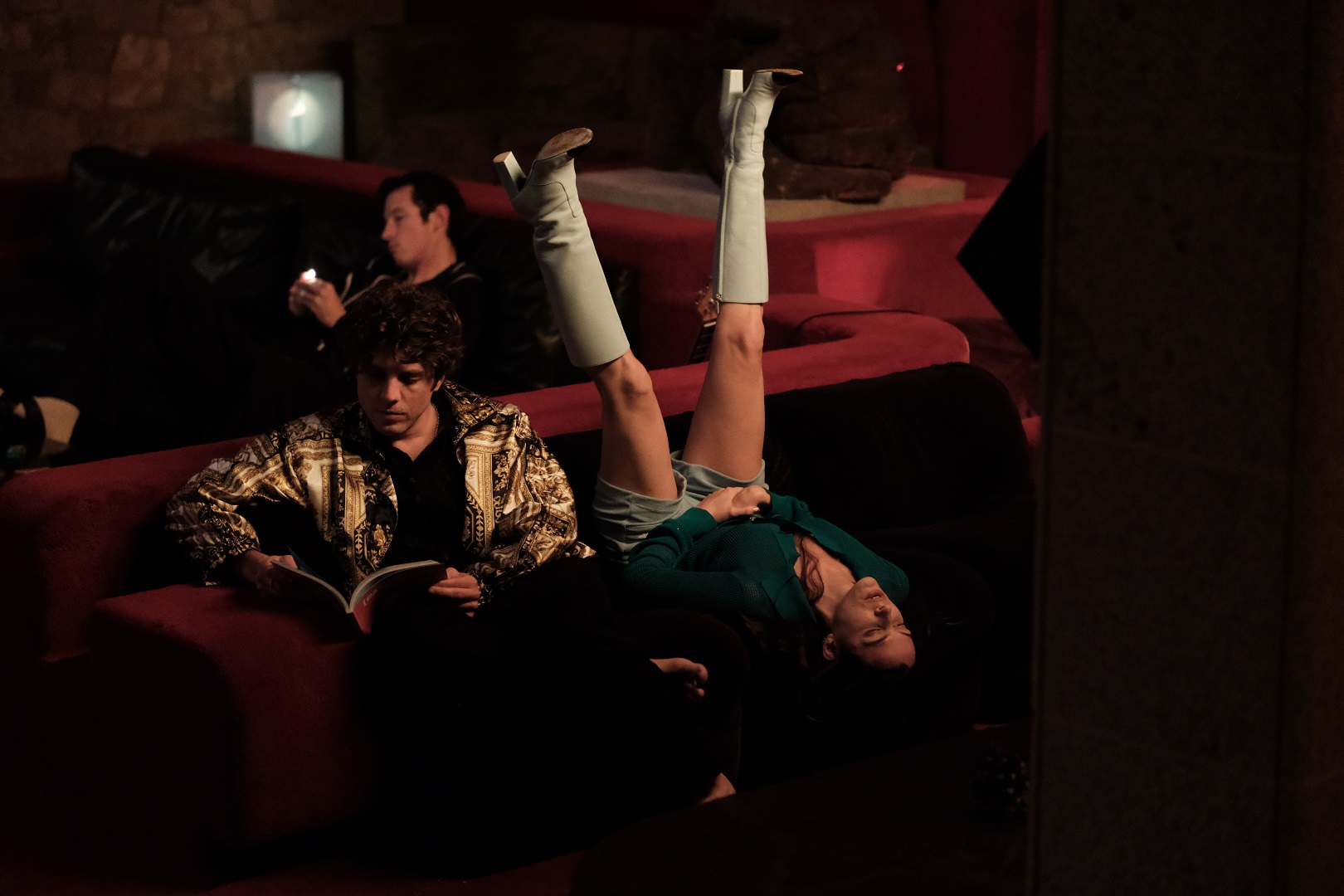
Karim Aïnouz's Rosebush Pruning lifts the skeleton of Fists in the Pocket, Marco Bellocchio's 1965 debut about a family consuming itself, and reupholsters it in couture. The screenplay comes from Efthimis Filippou, co-writer of Dogtooth and The Lobster, and the transplant announces the intent: Bellocchio's class rage is out, deadpan absurdism is in. The household is now American, obscenely rich, and parked on the Catalonian coast, maintaining what passes for closeness inside a sealed vacancy. The film premiered in competition at Berlin in February and opened Friday in select theaters through Mubi. It is beautiful the way a showroom is beautiful. That is the point, and also the problem.
Callum Turner narrates as Edward, the middle brother, introducing his relatives as hollow people who care for nothing beyond music and fashion, and the performance runs on exuberance, a man delighted by the rot he inventories. Jamie Bell plays Jack, the eldest and the only member permitted an interior life, and Bell makes the permission count; embarrassment and longing keep surfacing through the deadpan. His courtship of Martha, Elle Fanning's amateur guitarist, is the film's one channel of ordinary feeling, and Fanning plays her as a woman slowly reading the house's fine print. Riley Keough goes the other direction as sister Anna, tuned flat and precise, machinery by design. Tracy Letts presides as the blind Father. Pamela Anderson's Mother enters trailing a family legend about wolves.
The craft team builds the wall the concept requires. Hélène Louvart, Aïnouz's regular cinematographer, shoots on 35mm with color pushed to advertising pitch; every frame could sell you something. Perfume, probably. Rodrigo Martirena's production design answers her with upholstered maximalism, rooms that look commissioned rather than lived in. Matthew Herbert's score sits loud in the mix, almost adversarial, denying the images any calm. Three editors, Dávid Jancsó, Ilka Janka Nagy, and Heike Parplies, keep the scenes clipped and forward-leaning. Nothing here is accidental. The artifice is load-bearing.
Underneath runs an argument about violence inside a family, worn as intimacy. Filippou pushes the transgressions past shock into routine: bodily fluids as messaging system, cruelty as table manners. The sharpest scene is the smallest, a lunch where the Father asks Anna to describe the appearance of Jack's girlfriend aloud, and appraisal reveals itself as the family's only working language. The film refuses psychology and refuses likability; these people are exhibits, and the exhibit is the secession of the very rich from consequence. Aïnouz is not asking anyone to understand them. He is asking us to watch, at fashion-shoot range, what money does to a bloodline that has nothing left to want and no vocabulary for wanting it.
The wall has a cost. Bellocchio scandalized 1965 from inside a recognizable home; Aïnouz provokes 2026 from behind glass, and 2026 is hard to scandalize. Some provocations land as wounds. More land as design choices, admired and unfelt. The film seems aware of the ceiling and charges at it anyway, which plays as courage in one scene and decoration in the next.
The title comes from Edward's own invented proverb: a family is a rosebush, and a rosebush needs pruning. The film takes the saying at its word. Pruning is violence performed as care, and Rosebush Pruning is strongest when it lets the two stay indistinguishable. Aïnouz has made the prettiest possible film about people who mistake grooming for love. The shears gleam. The garden stays dead.