
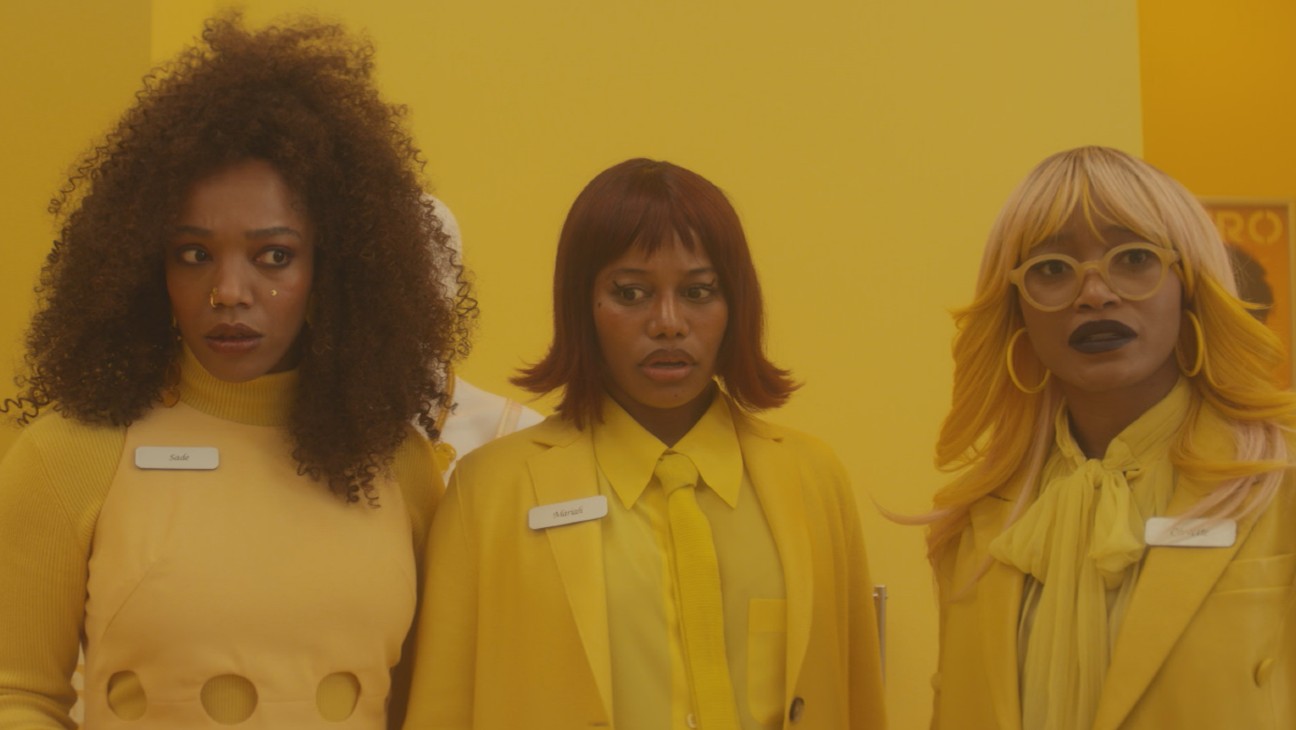
Eight years after Sorry to Bother You, Boots Riley returns with the same prosecutor's instincts and a sharper sense of where the absurdity already lives. I Love Boosters casts Keke Palmer, Naomi Ackie, and Taylour Paige as the Velvet Gang, a trio of Oakland shoplifters squatting in an abandoned chicken restaurant and lifting designer goods from a fashion mogul (Demi Moore) who has just slurred them publicly. The plot reads like a comedy. The film treats it as labor organizing. Riley does not soften the framing. The boost is the strike.
Palmer's Corvette is the work the film is built around. She plays a woman whose competence is the source of her humiliation: too smart for the system that prices her out, too aware of the joke to laugh at it for relief. Palmer does not perform anger; she performs the fatigue that comes from holding anger for years. Ackie gets the friendship-fraying subplot and gives it more weight than it earns from the script. Paige is funnier than the page gives her room to be. Demi Moore plays Christie Smith with the specific brittleness of someone who has been told she's a genius by an industry that needed her to be one. Will Poulter shows up as the lunch-break-rationing store manager and treats the cameo with the seriousness of a lead.
Natasha Braier photographs Oakland and the East Bay with a saturation Riley's last film hinted at and never fully released. Color belongs to the boosters. White rooms belong to capital. The film cuts between them without commentary because none is needed. Tune-Yards (Merrill Garbus and Nate Brenner) score with a hyperpop pulse that holds the heist sequences together and drops out the moment a character has to think. Production designer Christopher Glass and costume designer Shirley Kurata work in lime greens and hot pinks against the cool whites of Smith's brand world. The boosters' clothes read as evidence and inheritance at once. Matthew Hannam and Terel Gibson share the editing credit, and you can feel both temperaments: the maximalist who never met a sight gag he could not extend, and the cutter who knew when to land.
I Love Boosters refuses the comfortable shape of the anti-capitalist comedy. There is no awakening, no scene where Corvette comes to consciousness; she begins the film already there. There is no convincing capitalist either, no Christie Smith soliloquy explaining her own evil. Moore plays the role as a woman who has stopped justifying herself because she no longer thinks she has to. Riley sees the joke in the fact that her contempt is structurally identical to her affection. The system, in this film, is the weather the characters breathe. Stealing from it is treated as the only sane response.
Ackie and Paige are not given the room their performances earn. The Sade-Corvette friendship arc compresses what should have been the film's structural backbone into a few short scenes, and Mariah is funnier than the script lets her be. The second half goes full reality-hopping, and the rhetorical clarity of the third act arrives with a tidiness the middle stretch did not need to earn. The film is less interested in incident than in argument, and the argument is good enough to carry it.
NEON put it on 1,750 screens for Memorial Day, which is the right level of confidence for the work. Eight years after Sorry to Bother You, Riley has not mellowed and has not refined his way out of being himself. The boosters of the title are not metaphors. They are workers, taking back what was already theirs. The film closes on the inventory burning. Someone is laughing offscreen.