
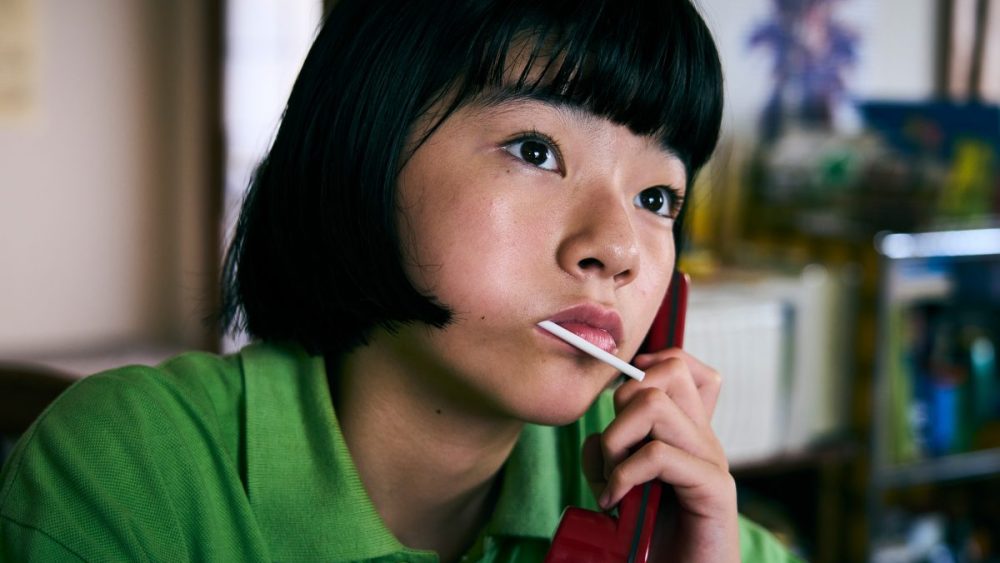
Chie Hayakawa made her name with Plan 75, a dystopia built on one chilling premise: a state program that pays the elderly to die. Her second feature throws the premise away and keeps the conscience. Renoir, which competed for the Palme d'Or at Cannes last year and now reaches US theaters through Film Movement, follows an eleven-year-old who declines to grieve on the schedule the adults around her expect. Fuki's father is dying of cancer. She meets it with curiosity instead of tears, and Hayakawa treats that refusal not as coldness but as a kind of clarity.
Yui Suzuki, in her first screen performance, carries the film on a single expression: a sideways, unhurried gaze that takes in death, lies, and adult panic with the same level attention. She never reaches for precocity. Lily Franky, as the father, plays dying without a trace of self-pity, a man receding politely from his own life. Hikari Ishida gives the mother a brittle exhaustion that curdles into something harder to watch; summoned to school over her daughter's essay, titled "I Want to be an Orphan," she is irritated by the inconvenience before she is worried about the child. The performances hold their own interior life. Nobody performs feeling for the camera.
Hayakawa reassembled most of her Plan 75 crew, and the continuity shows in the film's confidence. Cinematographer Hideho Urata photographs 1987 Tokyo in a warm, mobile light that catches at Fuki's hair as she freewheels downhill on her bicycle, the frame loose enough to feel like recovered memory rather than period reconstruction. Composer Remi Boubal scores it softly, melodic lines that slide into atonality just when comfort seems available. Editor Anne Klotz arranges the summer as a mosaic of episodes rather than a plot, each encounter weighted the same, the benign and the menacing given equal calm. The craft never announces itself. It trusts the child's eye instead.
What Renoir understands is that children are not unfinished adults. The film refuses the coming-of-age contract, the promise that a formative summer must transform its subject. Fuki ends the film as she began it, whole and unconvinced. Hayakawa also refuses to soften the adult world Fuki moves through: a fortune teller who blesses an affair, quack cancer cures sold to a dying man, a stranger Fuki meets on a lonely-hearts phone line whose interest in her is unmistakable and whom she goes to visit alone. The film holds these in the same patient frame, declining to flag the danger with music or close-up. The horror is that Fuki cannot yet tell the difference, because no adult has modeled honesty for her to copy.
The episodic build is also the film's risk. Renoir opens on an eerie VHS tape of crying children that it never fully earns, and its looseness can read as drift; viewers who want a summer to add up will find it withholding. But the diffuseness is the argument. A life at eleven does not organize itself into theme. It accumulates.
By the end, time has passed and circumstances have changed in the most devastating way the story allows, and Fuki absorbs it with the same unblinking calm. An English tutor, weeping over the news, insists she knows exactly how the girl feels. She does not. Renoir grants its protagonist the dignity of being unreadable, even to the people who love her. Not a soul but Fuki knows how Fuki feels. The film never tries to fix that. It calls it growing up.