
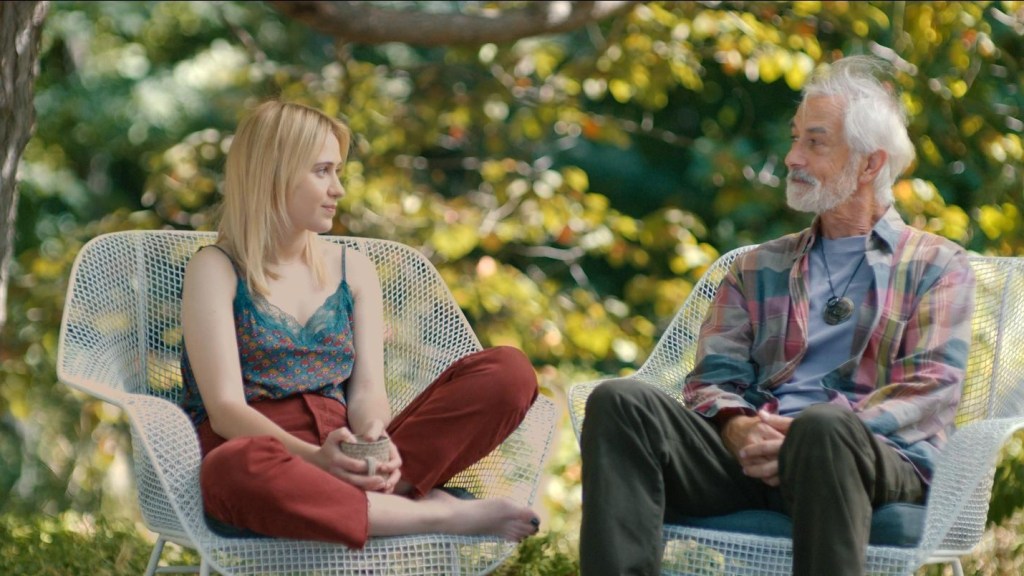
Madeleine Rotzler, the documentary filmmaker who released her earlier work under the name Madeleine Sackler, has built O Horizon around a premise that would have read as dystopian a decade ago and now reads like a product announcement. Abby, a New York neuroscientist, loses her father, then pays a one-man storefront operation to rebuild him. Feed it his texts, his voicemails, his Spotify, and a phone app returns a version that talks back, live if not alive. The film treats this as a story about healing. That is the choice that defines it, and the choice it never quite examines.
Maria Bakalova carries almost every frame, and she carries it with an openness that keeps the film watchable well past the point its ideas thin out. Her Abby is porous, easily moved past her own guard, slow to defend herself against a comfort she half-knows is false. David Strathairn plays the father, Warren, both in flashback and as the synthetic voice, and he refuses to mark a difference between the two. The living man and the facsimile share the same rumpled warmth. That flatness is deliberate, the most unsettling decision in the film, even as the script declines to press on it. Adam Pally, as the programmer selling grief by subscription, walks in from a sharper movie and leaves you wishing he had stayed.
Cinematographer Wolfgang Held shoots New York as a soft, moneyed haze, all greenhouse light and unlived-in apartments, a look that flatters Abby's sorrow without locating it anywhere real. Nathaniel Mechaly's score does similar work, washing the scenes in a consoling hum. Editor Pablo Barbieri keeps the picture in a slow drift, holding on Bakalova's face as though proximity were the same as access. The craft is competent and pretty. It is also complicit in the gauziness, smoothing every hard edge the premise should have kept.
There is a scene where Abby maps a lab monkey's brain, feeding it false stimulus until the screen blooms with color, then watching the color go black when the animal learns the comfort was fake. The film states its own thesis there, then refuses to believe it. O Horizon wants to ask whether a manufactured comfort is worth less than a real one, and it keeps flinching from the answer. It will not call the app a trap. It will not call it a cure. It settles for the position that some people, sometimes, might find the thing useful, and that we should probably ask questions.
That evasion is hard to separate from who made the film. Rotzler is the daughter of Jonathan Sackler, a co-owner of Purdue Pharma, the company that sold OxyContin as a comfort with no cost. Critics at RogerEbert.com and elsewhere have laid out the public record, including a crew member who left the production over it. A movie about a soothing substance that asks only mild questions about dependency arrives carrying a history it does not address. The parallel is not faint. The film's refusal to meet it reads less as restraint than as a door held shut.
None of this cancels Bakalova, who deserves a film with the nerve of its own idea. O Horizon is not that film. It builds a machine for synthetic comfort, then asks you to find the machine sweet. The sweetness is real. So is the dodge. A story about the cost of easy relief should be willing to name the cost. This one looks away.